Three families of match endings
Every major spectator sport falls into one of three structural families: running-clock sports, stop-clock sports, and untimed target sports. Once you sort a game into the right bucket, its pacing immediately clicks into focus.
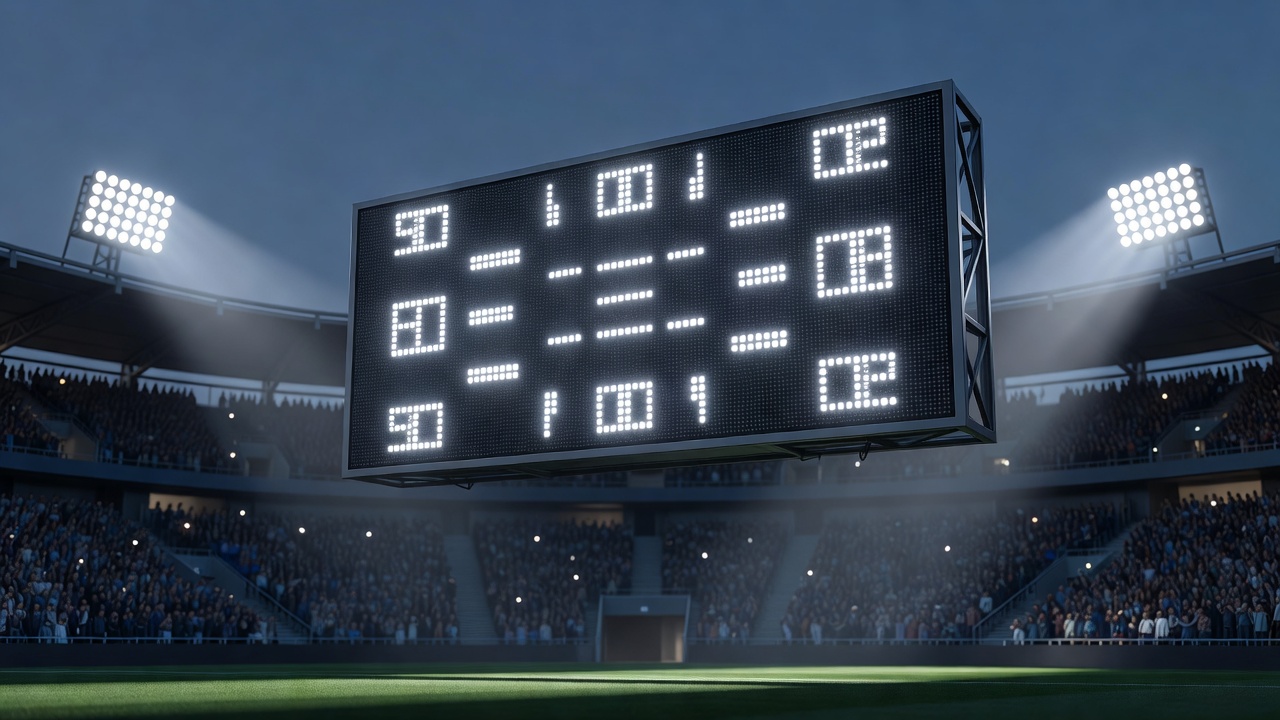
Running-clock sports include association football and rugby union. Under IFAB football rules, a match lasts two halves of 45 minutes with a 15-minute half-time rest, and the stadium clock keeps ticking during throw-ins, goal celebrations, and substitutions. Because those pauses eat up playing time, the fourth official holds up an electronic board near minute 45 and minute 90 showing the minimum "added time" (such as +4). Rugby union runs two 40-minute halves, and when the stadium clock hits 80:00 the game keeps going until the ball next goes dead—creating famous last-play drama when a trailing side refuses to kick the ball out.
Stop-clock sports include basketball, ice hockey, and American football. An NBA game features four 12-minute quarters (48 minutes of playing time), while FIBA international basketball—including the Olympic Games overseen by the International Olympic Committee (IOC)—plays four 10-minute quarters. Every whistle, out-of-bounds ball, or coach's timeout freezes the game clock. Basketball adds a second miniature timer above the backboard called the 24-second shot clock: the attacking team must hit the rim within 24 seconds or surrender possession, preventing anyone from hiding the ball to waste time.
Untimed target sports remove the clock completely. In tennis under ITF rules, players compete in sets; winning a set normally requires reaching six games while leading by at least two (such as 6–4). If both players reach 6–6, a quick "tiebreak" race to seven points (win by two) settles the set. Women's Grand Slam matches and most regular tour events are best-of-three sets (first to win two sets), whereas men's Grand Slam singles at Wimbledon, Roland-Garros, Melbourne, and New York are best-of-five sets (first to three). Cricket works on a fixed number of deliveries called "overs" (six legal bowls per over): a fast Twenty20 (T20) match gives each team 20 overs, One-Day Internationals allow 50 overs, and Test matches unfold across up to five days.
| Sport | Standard Length | Clock Style | What Happens If Tied? |
|---|---|---|---|
| Football (IFAB) | 2 × 45 min | Counts up + added time | Draw in leagues; 2 × 15 min extra time + penalties in knockouts. |
| Basketball (NBA / FIBA) | 4 × 12 min / 4 × 10 min | Counts down, stops on whistles | 5-minute overtime periods until one side leads. |
| Rugby Union (World Rugby) | 2 × 40 min | Counts up; ends on dead ball | Draw in pools; extra time or kicking contest in knockouts. |
| Tennis (ITF) | Best of 3 or 5 sets | No game clock | Tiebreak at 6–6 in a set; cannot finish tied. |
| Cricket (MCC) | 20 overs / 50 overs / 5 days | Ball count, not clock | Super Over in T20 ties; Tests can end in a draw if time expires. |
League tables versus knockout brackets
New fans often wonder why a team celebrates a 1–1 draw one week and looks heartbroken after a 1–1 scoreline the next. The answer lies in the competition format rather than the match rules.
In a league—such as Spain's La Liga or England's Premier League—every club plays every other club twice (once at home, once away) over nine months. Teams earn three points in the standings for a win, one point for a draw, and zero for a loss. Earning a draw away at a title rival's stadium can be a triumph because it keeps your points total climbing.
In a knockout tournament—such as the final rounds of the FIFA World Cup or Wimbledon—one loss sends you home. Draws are not allowed to stand, so ties trigger extra time, overtime quarters, or penalty shootouts. Some European football knockouts use "two-legged ties": two teams play once at each stadium, and their combined ("aggregate") score decides the winner. That explains why a team losing 1–0 on the night can still cheer at the final whistle if they won the first leg 3–0 a week earlier.
Format words worth knowing
What is a "penalty shootout" in football?
If a knockout match stays level after 90 minutes and 30 minutes of extra time, five players from each side take turns shooting from the penalty spot against the opposing goalkeeper. If still tied after five kicks each, it goes one kick at a time ("sudden death") until one team scores and the other misses.
Why do basketball coaches call timeouts in the last minute?
A timeout pauses the clock for roughly a minute so the coach can sketch a specific play on a whiteboard and—in the NBA—advance the ball to the front half of the court for a quicker final shot.
What is a "group stage" before knockouts?
Big international tournaments like the FIFA World Cup or Rugby World Cup begin with mini-leagues of four or five teams so every nation gets at least three matches before the top two qualify for single-elimination knockouts.